Category Archives: Teamwork

WHAT’S SO GOOD ABOUT TASKMASTER CLUB? LEADERSHIP

Week 5 — Leadership: Guiding, Listening and Adapting

Leadership is often misunderstood as something reserved for a few confident individuals at the front of the room. In reality, leadership is a set of skills and behaviours that can (and should) be developed in young people through practice, reflection and collaboration.

Taskmaster Club offers exactly that kind of environment.

Across each session, pupils take on leadership roles both formally and informally. They communicate ideas, negotiate approaches, make decisions under pressure, bring others with them, and adapt when things don’t work as planned. Leadership here is not about authority – it’s about influence, responsibility and collective success.


What Do We Mean by Leadership in Education?

Educational research increasingly views leadership as:

  • shared rather than hierarchical
  • situational rather than fixed
  • relational rather than positional

This idea of distributed leadership – widely discussed in education research – recognises that leadership emerges through interaction: listening, coordinating, motivating and guiding others toward a shared goal.

Crucially, leadership is not something pupils simply “have” or “don’t have”. It is learned through experience, especially in group-based, problem-rich environments.


Why Developing Leadership Skills Matters

Research and policy consistently highlight leadership as a vital life skill:

  • The Education Endowment Foundation (EEF) links leadership-related skills such as self-regulation, communication and metacognition to improved academic outcomes.
    https://educationendowmentfoundation.org.uk/education-evidence/teaching-learning-toolkit
  • UK educational leadership scholars such as Professor Alma Harris and Professor Christopher Day argue that leadership capacity should be developed early, through collaborative practice and shared responsibility.
  • Ofsted has increasingly emphasised personal development, teamwork, communication and responsibility – all closely tied to leadership behaviours – as part of what schools should be cultivating beyond exam outcomes.
  • Research on youth leadership development shows that pupils who are given structured opportunities to lead develop greater confidence, resilience, and engagement with learning.

In short: leadership skills support success in school, work and wider society – and they don’t develop by accident.


How Taskmaster Club Develops Leadership Skills

Taskmaster Club creates repeated, authentic opportunities for pupils to practise leadership in action.

1. Shared Decision-Making Under Pressure

Teams must make decisions quickly: which idea to pursue, how to use their time, who does what. Someone often needs to step forward to synthesise ideas and move the group on.

Research into leadership development highlights decisiveness and clarity – especially under time constraints – as core leadership skills. Taskmaster Club provides real, low-stakes practice.


2. Communication, Negotiation and Compromise

Leadership in Taskmaster Club is deeply communicative. Pupils must:

  • articulate their thinking
  • listen to others
  • negotiate disagreements
  • compromise for the good of the team

Research on collaborative learning and leadership stresses that effective leaders are strong listeners who create space for others’ voices – not those who dominate discussion.


3. Ensuring Everyone Is Heard

Successful teams are rarely led by the loudest voice. Instead, effective leaders notice who hasn’t spoken, draw out quieter ideas, and help the group weigh different contributions.

This reflects research on inclusive leadership, which shows that teams perform better when leaders actively foster participation and psychological safety.


4. Evaluating and Adapting Approaches

Leadership isn’t just about choosing a plan – it’s about recognising when it isn’t working.

Taskmaster Club tasks often require leaders to:

  • reassess strategies mid-task
  • respond to setbacks
  • adapt roles or approaches
  • keep morale high when things wobble

Educational research links this adaptive leadership closely to metacognition (thinking about thinking) which the EEF identifies as a high-impact teaching approach.


5. Rotating and Informal Leadership

Leadership in Taskmaster Club is fluid. One pupil may lead planning, another execution, another presentation or reflection.

This mirrors the distributed leadership models advocated by education researchers, which argue that rotating leadership roles builds wider leadership capacity and avoids reliance on a single individual.


Why Taskmaster Club Is an Ideal Leadership Environment

Taskmaster Club supports leadership development because it is:

  • Low-stakes — mistakes are safe and often humorous
  • Collaborative — leadership is social, not solitary
  • Time-bound — decisions matter
  • Varied — leadership takes different forms each week
  • Reflective — teams should evaluate both outcomes and processes

Most importantly, leadership is practised authentically, not simulated.


Practical Ways to Make Leadership Explicit in Your Club

If you run a Taskmaster Club, you can strengthen leadership development by:

  • Rotating team roles deliberately (planner, coordinator, presenter, reviewer).
  • Asking teams to identify who helped move the group forward – and how.
  • Highlighting good leadership behaviours in feedback, not just good results.
  • Encouraging reflection on decisions: What worked? What would you change?
  • Valuing listening and facilitation as much as bold ideas.

Final Thought

Leadership is not about standing out – it’s about bringing others with you.

Taskmaster Club gives young people repeated chances to practise leadership in its most meaningful form: guiding discussion, making decisions, adapting strategies, and keeping a team moving forward together. Through communication, compromise and reflection, pupils learn that leadership is not a title – it’s a skill.

And if they learn that while managing a ticking clock, balancing wildly different ideas, and rescuing a plan that’s gone slightly off the rails?
That’s leadership worth developing.

Taskmaster Club materials:

Further posts in the ‘What’s So Good About Taskmaster Club series:

WHAT’S SO GOOD ABOUT TASKMASTER CLUB? PROBLEM SOLVING

Week 4 – Problem Solving: Thinking Flexibly, Together

Problem solving is one of the most frequently cited “essential skills” in education, and one of the hardest to teach well. It’s not simply about getting the right answer, but about how learners approach unfamiliar challenges, adapt strategies, and apply thinking across different contexts.

Taskmaster Club is particularly powerful here. Each session presents teams with unusual, open-ended problems that must be interpreted, planned for, tested and revised – often under time pressure, often collaboratively, and often with unpredictable results. This repeated exposure to varied problems helps young people build transferable problem-solving habits, not just isolated techniques.


What Do We Mean by Problem Solving in Education?

Educational research defines problem solving as a process, not an outcome. It typically includes:

  • understanding and defining the problem
  • planning an approach
  • selecting and testing strategies
  • monitoring progress
  • adapting when things don’t work
  • reflecting on outcomes and processes

Crucially, strong problem solvers are not those who memorise solutions, but those who can transfer strategies to new situations — a key focus of current UK educational research.


Why Problem Solving Matters (Research & Policy Context)

Problem solving has become increasingly prominent in education policy and research:

  • The OECD highlights problem solving as central to preparing learners for complex, uncertain futures, particularly when problems are ill-defined and collaborative.
  • In England, the Education Endowment Foundation (EEF) identifies metacognition and self-regulation – closely linked to problem solving – as having a high impact on pupil attainment.
  • UK cognitive science research (including work synthesised by Dunlosky et al., widely used in teacher education) shows that learners improve problem solving when they are explicitly taught how to plan, monitor and evaluate their thinking.
  • Research from the University of Cambridge on dialogic learning demonstrates that reasoning with others improves individual problem-solving ability over time.

Together, this evidence points to a clear conclusion: problem solving improves when it is modelled, practised across contexts, and supported through structured talk and reflection.


How Taskmaster Club Develops Problem Solving Skills

Taskmaster Club is particularly effective because it exposes learners to many different types of problems, requiring flexible application of strategies rather than repetition of a single method.

1. Interpreting Ambiguous Problems

Task instructions are rarely straightforward. Teams must read carefully, clarify meaning, challenge assumptions, and agree on what the problem actually is.

This aligns with research showing that expert problem solvers spend more time understanding a problem before acting — a skill that can be taught, modelled and practised.


2. Strategic Planning and Time Management

Once a task is understood, teams must decide:

  • what their goal is
  • how to use limited time and resources
  • which strategy is most likely to succeed

This reflects research on metacognition, which emphasises planning and monitoring as core components of effective problem solving. Taskmaster Club provides repeated, authentic opportunities to practise these skills.


3. Collaborative Problem Solving

Most Taskmaster Club tasks are approached in teams. Participants must:

  • share ideas
  • justify their reasoning
  • negotiate disagreements
  • compromise and adapt

Research into collaborative problem solving (including studies on dialogic teaching) shows that explaining thinking aloud and responding to others’ ideas strengthens reasoning and improves solution quality. Taskmaster Club embeds this naturally.


4. Trial, Error and Productive Failure

Many Taskmaster attempts fail — sometimes spectacularly. But failure here is informative, not punitive.

Educational research on productive failure shows that struggling with a problem before reaching a solution leads to deeper understanding and better long-term transfer. Taskmaster Club normalises iteration: test, fail, adapt, try again.


5. Questioning and Information Seeking

Successful teams often:

  • ask clarifying questions
  • look for hidden clues
  • check interpretations
  • seek additional information

Inquiry-based learning research consistently identifies questioning as a key driver of effective problem solving. Taskmaster Club rewards curiosity and strategic questioning rather than blind action.


6. Reflection and Transfer

After each task, teams can reflect on:

  • what worked
  • what didn’t
  • why
  • what they’d change next time

Reflection is critical. EEF guidance highlights that metacognitive reflection helps learners transfer strategies to new problems. Taskmaster Club allows this reflective loop into every session.


Why Taskmaster Club’s Approach Is So Effective

Taskmaster Club creates ideal conditions for problem solving because it is:

  • Low-stakes — failure is safe and often funny
  • Varied — problems differ from task to task and week to week
  • Social — thinking is shared and challenged
  • Time-bound — encouraging prioritisation
  • Engaging — motivation remains high

Most importantly, students encounter problems that don’t look like school problems — which is exactly what helps problem-solving skills transfer beyond the classroom.


Practical Ways to Make Problem Solving Explicit in Your Club

  • Ask teams to articulate their plan before starting.
  • Pause mid-task to encourage strategy review.
  • Highlight good questions as much as good answers.
  • Celebrate effective adaptations, not just success.
  • End sessions by identifying one problem-solving strategy teams would reuse elsewhere.

Final Thought

Problem solving is not a single skill but a habit of mind – one that develops through varied practice, collaboration, reflection and the freedom to fail safely.

Taskmaster Club offers young people repeated, joyful opportunities to practise this habit. By tackling strange, unpredictable challenges together, they learn not just how to solve a task — but how to approach problems wherever they appear.

And if they learn that while racing the clock, negotiating with teammates, and defending a slightly ridiculous plan?
That’s problem solving at its best.

Taskmaster Club materials:

Further posts in the ‘What’s So Good About Taskmaster Club series:

What’s So Good About Taskmaster Club? ORACY

Week 3 — Oracy: Speaking, Listening & Thinking Out Loud

In education, we often celebrate reading, writing, arithmetic – but too often we forget the power of talk. That’s where oracy comes in: the ability to express ideas clearly, listen deeply, reason with others, and adapt language to different contexts. For many young people, that’s just as important, if not more so, than any other skill.

With its team-based, often chaotic, always creative structure, Taskmaster Club offers a brilliant environment for oracy to flourish. Teams must plan, defend, revise and sometimes persuade one another that their strange idea is “the one.” In doing so, they practise real-world communication and develop confidence, clarity and collaborative thinking.

Below: how Taskmaster Club builds oracy — and why growing oracy skills matters now more than ever.


What is Oracy — and Why It Matters

  • The term “oracy” was coined in the UK in the 1960s by the British educator Andrew Wilkinson. The idea was to give spoken language skills equal status with literacy and numeracy.cambridge-community.org.uk+1
  • According to the most recent report from the Commission on the Future of Oracy Education in England (2024), oracy should become the “fourth R” of education — as vital to children’s development as reading, writing and arithmetic.oracyeducationcommission.co.uk+1
  • Oracy means more than just speaking: it encompasses reasoning together, listening, adapting communication, arguing respectfully, and engaging in collective thinking.Artis+2Research Schools Network+2

In a time where clear communication, empathy, argumentation and collaboration are increasingly vital (in school, society and future workplaces), oracy is something we cannot afford to neglect.


What Research & Policy Are Saying (UK Focus)

  • According to the University of Cambridge’s educational research, when students are taught to reason together — to use talk to think with others — they become better at reasoning individually too.University of Cambridge
  • Studies show that purposeful classroom talk and oracy-recognition improve academic achievement, support social and emotional development, and build skills essential for life beyond school: confidence, expression, civic engagement and agency.ESU+2Research Schools Network+2
  • Recent national-level reviews (like that of the Oracy Commission) argue for integrating speaking & listening — across all subjects and extracurriculars — to prepare young people for a world where communication, discussion and collaboration are key.sec-ed.co.uk+2oracyeducationcommission.co.uk+2

In short: oracy isn’t just “nice-to-have”. It’s a foundational competence – socially, academically, professionally.


How Taskmaster Club Nurtures Oracy in Every Session

Here’s how the Club’s structure naturally builds oracy – often without students realising they’re “learning”.

  • Constant justification & persuasion: Teams discuss how to approach tasks, negotiate ideas, and defend why one plan is better than another. That builds clarity of thought — and the confidence to express it.
  • Collective reflection: After every challenge, participants talk through what worked, what failed, and what they’d do differently. That encourages listening, evaluation, and shared understanding.
  • Role-sharing & leadership language: Teams rotate roles — planners, doers, presenters — which gives everyone a chance to speak, lead, or support. That variety cultivates flexible communication styles.
  • Spontaneous collaboration under pressure: Many tasks are time-pressured, chaotic or absurd: teams must think quickly, adjust plans, and communicate on the fly. That helps build adaptability and real-world readiness.
  • Inclusive, low-stakes environment: Because tasks are playful and creative rather than “test-based,” students are more willing to experiment with ideas, make mistakes, speak up and learn from each other.

Why Oracy — and thus Taskmaster Club — Matters More Than Ever

  • With the recent push (via the Oracy Commission) to recognise oracy as the “fourth R,” schools and educators are being encouraged to embed speaking and listening skills across all areas of learning. Taskmaster Club is already doing this — in a way that feels fun, not forced.
  • As workplaces, communities and societies become more collaborative, global and fluid, strong communication, confidence, and the ability to reason with others are increasingly vital. Oracy helps equip young people for that reality.
  • For many learners — especially those less confident in writing or those from under-resourced backgrounds — oracy provides another route to express their thinking, show their knowledge, and contribute meaningfully. It’s equitable, empowering, accessible.

Practical Ideas to Boost Oracy in Your Club

If you run a Taskmaster Club (or are thinking of starting one), here are some concrete ideas to make oracy explicit — and build it intentionally:

  • At the end of each task, spend a few minutes debriefing: ask each team member to say one thing they liked about someone else’s idea, and one improvement they’d suggest.
  • Run tasks that require verbal presentation — so teams have to pitch their ideas out loud, describe their methods, or explain their thinking under a time limit.
  • Rotate roles deliberately — ensure quieter students get a chance to lead discussion, speak, or summarise the group’s thinking.
  • Encourage discussion of choices: when a plan fails, ask teams to reflect aloud on why, what they might do differently — celebrate “good thinking, even if the result was exactly what was hoped for.”
  • Use mixed media: some tasks should require strategy talk (planning, reasoning), others storytelling or performative explanation — giving varied opportunities for oracy development.

Final Thought

Oracy isn’t a luxury. It’s a human right: the right to think aloud, to express, to reason, to contribute. And in a world increasingly shaped by communication — between communities, workplaces, nations — oracy is as vital as reading, writing or arithmetic.

With its blend of teamwork, challenge, play and reflection, Taskmaster Club gives young people a rare gift: regular, joyful, purposeful opportunities to speak, listen and think together. It doesn’t just help them win silly tasks — it helps them find their voice.

Taskmaster Club materials:

Further posts in the ‘What’s So Good About Taskmaster Club series:

Secret Tasks: The Unexpected Key to Obvious Impact

Last week, I had the pleasure of visiting Southway Primary School, where their Year 6 pupils have been running Taskmaster Club this term.

I was there to learn more about a collaborative project they’re planning with their neighbouring secondary school, TRS, and it’s an idea that’s simple but could well be extremely impactful. Older pupils from TRS will take on leadership roles, running Taskmaster Club sessions for the younger pupils and modelling collaborative teamwork and communication. It’s peer-led, it’s practical, and it’s the kind of initiative that quietly builds confidence in all age groups. I can’t wait to see what happens next and the ripple effect it has across both schools.

But that wasn’t the highlight of the visit.

The Teacher Who Introduced Me to the “Secret Task”

While speaking with a teacher who has been running Taskmaster Club with Post-16 pupils, she shared an adaptation she had made to the format. It was so clever, simple, and bursting with potential that I’ve been thinking about it ever since.

She had introduced The Secret Task.

While all of the teams were working on the same task, she privately assigned individual pupils an extra rule or personal mission to complete during the session. These were designed to shape behaviours, build skills, or push pupils slightly outside their comfort zones – all while keeping the playful spirit of Taskmaster intact.

The sorts of secret tasks she shared included:

  • Make sure your team uses your idea for at least one task today.
  • You must agree with everything everyone says.
  • Do not speak at all during the session today.
  • Sabotage your team’s attempt in some way. If your team win, they lose; if they lose, you gain bonus points; if you get caught, you lose points.

Each one requires a different kind of strategy, awareness, and self-management. And each one develops a different skill.

Why Secret Tasks Work So Well

What struck me most wasn’t just the creativity of the idea—it was the intentionality behind it.

Secret tasks give teachers an opportunity to:

1. Personalise the learning experience

Each pupil can be guided toward a specific behaviour, challenge, or strength. A quieter pupil could have a task encouraging leadership; a dominant pupil could be nudged toward active listening; someone who struggles with teamwork could be steered into building or repairing group dynamics. All while attempting the same task.

2. Strengthen inclusion and adaptive practice

We talk a lot about adaptations, but this is adaptive practice disguised as fun. It gives every pupil a way to participate meaningfully, even if their needs or strengths differ from their peers’. No one is singled out. No one is left out. Everyone plays.

3. Encourage reflection and metacognition

Secret tasks aren’t just playful – they support deeper thinking. When pupils debrief afterwards, they start to notice how behaviours influence the outcome of a team task. They learn to reflect on what worked, what didn’t, and how their own actions shaped the group.

4. Maintain the magic of Taskmaster

Taskmaster thrives on chaos, surprise, and joyful unpredictability. Secret tasks add another layer of mystery that feels perfectly in keeping with the spirit of the format.

An Obvious Impact Through Subtle Means

What I love most is how quietly transformative the secret task can be. It’s a small tweak with the potential for huge impact. When used purposefully, it allows any teacher or facilitator to:

  • build confidence
  • develop communication skills
  • challenge assumptions
  • support social interaction
  • nurture leadership
  • encourage teamwork
  • and gently shift behaviours

…all without breaking the flow of the session or drawing attention to any one pupil’s needs.

This, to me, is inclusive practice at its best: playful, personalised, and powerfully human.

What Secret Tasks Would You Add?

I left Southway feeling inspired – not just by what they’re doing now, but by the possibilities these secret tasks unlock. I’d love to hear other ideas and adaptations people are using in their clubs, classrooms, or youth group sessions.

Sometimes the smallest twist creates the biggest shift. And sometimes, a secret task is the most obvious way to make an impact.

What’s so good about Taskmaster Club? CREATIVITY

Taskmaster Club is built on unpredictability, play and lateral thinking – exactly the conditions that let creativity breathe. Because the Club’s tasks rarely have a single “right” answer, teams must invent their own routes to success. That open-endedness, combined with a rich mix of music, drama, art and hands-on making, creates repeated, scaffolded chances to practise creative thinking — in other words, creativity isn’t an occasional add-on: it’s the curriculum.

Below we explore how Taskmaster Club develops creativity, what the academic evidence says (with a UK focus), and how these playful tasks nurture the kind of creative thinking young people need today.

Why Taskmaster-style tasks are great for creativity

  1. Open outcomes = generative thinking
    When tasks don’t prescribe a method or final form, teams must ask “what could this be?” not “what must this be?” That shift from replicating a model to possibility thinking is central to creative development: it invites hypothesis, experimentation and risk-taking — the very habits Anna Craft identified as core to creative learning (she coined and championed the idea of possibility thinking). Open University BERA
  2. Constraints actually help creativity
    Paradoxically, tight constraints (time, materials, silly rules) focus creative exploration. Taskmaster tasks often force teams to be inventive within limits — and research across creative pedagogy shows that constraint-driven tasks stimulate fluency and originality by encouraging lateral approaches rather than formulaic solutions. (See examples in creativity collaboratives and school-based action research.) ACE+1
  3. Multimodal practice builds creative flexibility
    Because Taskmaster tasks can require music, drama, visual art, spoken word, or engineered props, students repeatedly practise transferring ideas across modes. This multimodal practice is important: creative expertise grows when learners can move ideas between media, testing which forms best express a concept. The national Creativity Collaboratives and university-school partnerships emphasise this cross-disciplinary approach. Durham Commission on Creativity and Education | Arts Council England
  4. Collaborative creativity is richer than solo creativity
    Teams bring different perspectives and skills; this collision of ideas leads to novel combinations. UK scholars working on creative classroom practice note that well-structured collaboration helps students -externalise ideas, receive immediate feedback, and iterate – turning initial sparks into refined creative products. Professor Teresa Cremin’s work on creative pedagogy emphasises the value of teacher-facilitated but learner-led creative activity, where peer interaction and teacher support combine to sustain risk and exploration.
  5. Low-stakes play creates the behavioural safety to be bold
    Taskmaster Club’s playful framing reduces fear of failure. When “failure” is comical or temporary, learners are more likely to take original risks – which is where real creativity often happens. Research from school collaboratives shows that embedding creative tasks as part of a supportive school culture increases children’s willingness to experiment. University of Exeter News+1

Sir Ken Robinson: Creativity as a Human Right

No discussion of creativity in education is complete without Sir Ken Robinson, whose work transformed how teachers, schools and policymakers think about human potential. Robinson famously argued that “creativity is as important as literacy” — not as a slogan, but as a recognition that imagination and expression deserve the same value as traditional academic skills.

He also emphasised that creativity is not confined to the arts: it is a mode of thinking that cuts across every discipline, powered by curiosity, divergent thinking and the willingness to try something new. Crucially, Robinson championed learning environments where experimentation, improvisation and playful failure are embraced rather than avoided.

Taskmaster Club embodies these principles beautifully. Its open-ended challenges, humorous framing, and celebration of unconventional approaches create exactly the conditions Robinson believed young people need to develop their creative capacities.


What the UK evidence tells us (short takeaways)

  • Possibility thinking matters. Anna Craft’s research established that the move from “what is” to “what might be” is a repeatable, teachable mode of thinking – precisely what Taskmaster-style tasks provoke. BERA
  • Creative pedagogy is most effective when it’s supported, structured and inclusive. Projects like the Creativity Collaboratives and university-school partnerships show that creative teaching yields deeper understanding and longer-term skill development when teachers scaffold opportunities and assessment recognises process as well as product. ACE+1
  • Teacher and peer support amplifies creativity. Teresa Cremin and colleagues emphasise that teachers who model risk, reflect openly, and give careful feedback help students sustain creative efforts beyond momentary sparks. Open University Profiles+1
  • Creativity connects to broader futures skills. National reports and interdisciplinary research (including engineering and design education) emphasise that creative problem-solving is essential for future workplaces — and school-based creative projects are a key route to develop it. Royal Academy of Engineering+1

How Taskmaster Club specifically nurtures those ingredients

  • Regular, varied practice: Weekly sessions give repeated opportunities to ideate, prototype and reflect — crucial cycles described in creativity research.
  • Cross-disciplinary prompts: A single challenge might require story, sound, visuals and a practical build — mirroring real-world creative problems that demand transferable skills.
  • Peer feedback and reflection: Debriefing after challenges turns fun into learning: what worked, what surprised us, what would we try differently next time? That reflective loop is essential for creative improvement.
  • Design for inclusivity: Rotating roles (idea generator, maker, presenter) and mixed-ability teams let different strengths surface; university-school projects show inclusive design increases all pupils’ creative confidence. Birmingham City University+1

Practical tips to amplify creativity in your Club

  1. Value the idea, not just the result. Highlight smart failures and surprising attempts in your feedback.
  2. Introduce micro-constraints. Short time limits or limited materials often spur greater invention than total freedom.
  3. Rotate media. Running a task that specifically requires music or drama helps pupils practise transferring ideas.
  4. Make reflection explicit. Use team reflection time after tasks: what’s one idea we’d keep, one we’d drop, one we’d try differently?
  5. Share and celebrate process. Put up process photos/sketches in school spaces – creativity sees greater uptake when its process is visible.

Final thought

Creativity isn’t a mysterious trait you either have or don’t — it’s cultivated through repeated, scaffolded practice, risk-friendly environments, multimodal tasks and supportive collaboration. Taskmaster Club offers a compact, joyful ecosystem where all of those elements meet. It’s not just entertaining: it’s a practical engine for building future-ready creative thinkers.


Further reading & resources

  • Anna Craft — background and the idea of possibility thinking. BERA
  • Teresa Cremin — creativity, teacher practice and peer-supported creative learning. Open University Profiles+1
  • Creativity Collaboratives / Arts Council England — school–university partnerships embedding creative pedagogy. ACE+1
  • Royal Academy of Engineering — on creativity and engineering education (practical, interdisciplinary creativity). Royal Academy of Engineering

Taskmaster Club materials:

Further posts in the ‘What’s So Good About Taskmaster Club series:

What’s So Good About Taskmaster Club? TEAMWORK

Teamwork: A Foundation for School & Work Success

In the first post of our “What’s So Good About Taskmaster Club?” series, I want to highlight perhaps the most powerful benefit: teamwork.


Why Teamwork Matters in Taskmaster Club

At its heart, Taskmaster Club is built on collaborative challenges. Participants tackle creative, often quirky tasks in teams, learning not only to be imaginative, but also to work together strategically. Here’s how this fosters teamwork:

  1. Shared Goals & Collective Problem-Solving
    • By working in teams, students must negotiate who does what, combine strengths, and decide together how best to tackle a task.
    • This shared problem-solving builds trust, responsibility, and a sense of shared ownership of both success and setbacks.
  2. Communication & Feedback Loops
    • Team members learn to articulate ideas clearly, listen actively, and respond to each other’s suggestions — especially when time or resources are limited.
    • They also learn to give and receive feedback, which fosters openness and mutual respect.
  3. Accountability & Role-Distribution
    • Each person needs to contribute; in Taskmaster challenges, one teammate’s bottleneck can slow the whole group. That means students learn responsibility, and how their part fits into the bigger picture.
    • Roles emerge (leader, doer, thinker, encourager) — and shifting roles helps build adaptability.
  4. Resilience Through Collaboration
    • When things go wrong (and they often do), teammates support each other, adjust strategies, or pivot together. Failure becomes a learning moment, not just an endpoint.

The Real-World & Academic Payoffs of Teamwork

Developing strong teamwork skills isn’t just “nice to have” – it’s a critical life skill, backed by academic research and essential in modern work environments.

  • Rachael Carden, Sarah Cork, and Liz Marks carried out research at the University of Brighton on inclusive collaboration. They emphasise designing group assessments so that process (how a team works) matters as much as the final outcome — reinforcing resilience, belonging, and shared agency. Brighton Research
  • Connie Pritchard, Zoe Prytherch, and Nigel Francis from Cardiff University co-authored a recent study “Making teamwork work: enhancing teamwork and assessment in higher education”. They note that despite the challenges, teamwork is one of the most sought-after graduate skills, but group-based assessments often fail unless careful structures are in place. Orca
  • Lucy Chilvers, in a UK peer-learning context, wrote about a “peer-to-peer model” where collaboration is inclusive, respectful, developmental, and accountable. Journal of Peer Learning
  • Claire Dickerson and Joy Jarvis, among others, studied staff-student collaboration in higher education in the UK and found that students working with academics “identified learning … in relation to employability skills … and … their perceptions of themselves as learners”. researchprofiles.herts.ac.uk
  • According to an educational study, teamwork skills are “integral to success in today’s professional world”, and working in groups helps students build collaboration, motivation, and persistence. ERIC
  • Cooperative learning (i.e., structured group work) has been shown to boost academic performance, because the shared knowledge and peer explanations deepen understanding. Pepper Pot+1
  • Teamwork also cultivates social and emotional intelligence — empathy, conflict resolution, and listening — which are foundational for both school and workplace relationships. goldstareducation.com+1
  • Research in higher education shows that collaboration helps students adapt to “multidisciplinary groups … improving their motivation, persistence, and professional skills.” ERIC
  • On a more systemic level, one study found that “collaborative knowledge building” via cooperative learning is increasingly favoured over traditional teacher-centred approaches to prepare students for workforce realities. uijrt.com

In short: teamwork isn’t a bonus skill — it’s an academic accelerator.

And in educational settings, children who engage in strategic reciprocity – cooperating in their peer social networks – tend to perform better academically. arXiv


Why Teamwork in Taskmaster Club Gives Unique Value

Putting all this together, Taskmaster Club offers something special:

  • Low-stakes experimentation: The playful, creative format means students can try out teamwork and an array of approaches to tasks without the heavy pressure of graded assignments.
  • Reflective learning: After each task, teams can reflect on what worked, what didn’t, and how to improve – building a growth mindset.
  • Real collaboration: Unlike more “artificial” school group work, tasks in Taskmaster Club are unpredictable and require genuine collaboration, creativity, and compromise.
  • Transferable skills: The teamwork habits developed (communication, accountability, adaptability) map directly onto both academic group projects and professional teams.

Why This Matters for Schools and Employers

  • For Schools: Taskmaster Club helps embed collaborative learning into school culture, supporting students’ academic and social development in an engaging, fun way.
  • For Employers: Students who learn to work in creative teams – and who understand how to navigate uncertainty, delegate, and adapt – are more prepared for modern, agile workplaces.

Want to Learn More?

Taskmaster in the Classroom

If you have found your way to this blog because of Alex Horne, then hello and welcome. I am James, a deputy head and class teacher in West Sussex. If you just want the resources and link to a great introduction video then scroll to the bottom of the page. If you want to get involved with TaskmasterEducation then visit our website. Otherwise, on with the post…

We wanted to improve the way our children communicate with each other and my Head suggested this could be achieved by doing some team building challenges. It didn’t take my mind long to turn to Taskmaster. Taskmaster is a British TV programme which has just completed its 8th series.  5 comedians are set tasks by Greg Davies (the Taskmaster) and his sidekick Alex Horne (the creator of the show) and much hilarity ensues.  And so, we held Taskmaster Week.

These sort of tasks appealed to me because of their random and varied nature, meaning that all children can access them and anyone could win. Those who did the best at each challenge were the ones who communicated the clearly and persevered, and sometimes they were just lucky.
My ideas for the tasks came mostly straight from the show and the brain of Alex Horne, but they needed to adapted to make them all team tasks, suitable for children, safe and relevant to our setting. I then put them into 5 categories: Challenge Tasks which take between 5 and 30 minutes; Physical Tasks for our PE lesson; Quick Tasks to be completed in under 5 minutes; Long Term Tasks to be completed over the week and scored on the final day; and End of the Day Tasks which the children are to complete over night.

Challenge Tasks
  1. Scavenger Hunt
  2. Paint a picture – blindfolded
  3. Take an impressive photograph
  4. Throw a tea bag into a mug from the furthest distance
  5. Get an egg as high as possible, without breaking it
  6. What is Mr Blake-Lobb’s age in minutes?
  7. As a team, build the highest tower on the field. You have ten minutes starting from now.
  8. Memorise the Highwayman poem
  9. Set a task for another group
  10. Draw an upside down self-portrait using crayons
  11. Make the most juice from these fruits
  12. Make the best picture, using only this toilet roll.
  13. Unveil a new handshake
  14. Make something spin for the longest period of time
  15. Make the best paper aeroplane. Furthest flight wins.
Physical Tasks
  1. Score a goal with a shopping bag, each team member must kick the bag at least twice
  2. CONNECTED TASK – Make the shopping bag as heavy as possible in ten minutes. It must then hang, unassisted, for one minute
  3. Make the most impressive throw of something, into something
  4. Do the most brilliant thing on a gym mat
  5. While holding hands, kick a rugby ball from the round house to the year 6 table
  6. Move the pallet as far as possible. You have 3 minutes. Go.
Quick Tasks
  1. Guess the number on Mr Blake-Lobb’s left arm.
  2. Vote for the team you wish to receive 5 points. If you vote for your own team and don’t win, then you will lose 2 points
  3. Write the lowest unique number on a whiteboard
  4. Stand up for 100 seconds
Long Term Tasks
  1. Bring me someone who was born on the 28th May 2011
  2. Surprise Mr Allen
  3. Impress Mr Wood
  4. Make Mrs Humphreys say ‘bubbles’. You cannot use the word ‘bubbles’
  5. Make Mrs Rowe laugh out loud. You must not touch her.
  6. As a team, stage a performance of a nursery rhyme
  7. Write a perform a song about this week
End of the Day Tasks
  1. Bring in a book to read to a younger child
  2. Tweet a joke to Penguins class, 1st joke wins (Bonus for best joke)
  3. Wear the most unusual hat to school tomorrow
Rules

We also needed to set a few ground rules before we embarked on the week:

  • Be ready, respectful and safe at all times
  • The Taskmaster’s decision is final
  • Points can be taken away
  • Do not put yourself or others in danger
  • You may ask The Taskmaster any question you like: questions asked publicly will be answered publicly; questions asked privately will be answered privately; but he does not have to answer the question
  • If you move something, put it back
  • If you make a mess, clean it up
  • Bonus points can be won
  • Do not argue with The Taskmaster, your team mates, or members of other teams
  • Any team member leaving the room must sign out
  • Always knock before entering a classroom and wait for a response
DAY 1

We carefully went through the rules, emphasising the need to be ready, respectful and safe at all times, then got on with the tasks. First up was a scavenger hunt, 18 items to find from all over the school. On a safeguarding note, each group had a sign out sheet, so if they left the room they had to specify where they were going. Groups had a point deduction if this was forgotten.

Next the children were asked to work out my age…in minutes. They all had a go. The closest was 15 million minutes out. Some work to do in maths, but I was impressed by their attitude and approach to the challenge.

They were challenged to come up with their own team name, but it had to include my year 6 colleagues favourite word. There was no way of finding out the favourite word of the teacher, so they had to guess. During lunch time, my colleague put the group names into order and point were allocated. Also over lunchtime, the children set to work on their long term tasks. Fairly quickly, one group persuades another colleague to use the word ‘bubbles’, cunningly following up another kids who got her to say ‘bubble’. They simply walked up behind and said, ‘what if their was more than one?’ A great moment, and a lesson learnt for all. The same group were able to bring me a child born on 28th May 2018. I was pleasantly surprised at how quickly they managed to do this.

In the afternoon, they were challenged to learn The Highwayman poem. This, as it turns out, is more of a long term task. We’ll see if and when they get that one done. Next, blindfold drawing. Once completed, the team captains lined them up and I chose the best collections of art work. A interesting array of work, mostly landscapes, pigs, stars and a Christmas tree. I should probably collect them in and submit them for psychological analysis.

The big task this afternoon was simply…build a tower. So they did. See pictures below. It had to be free standing, which wasn’t so easy on a rainy day, and everything had to be put back again afterwards exactly where it came from. Bonus points for the tidiest team.

To end the day, the children began their diary of the week. Reflecting on what was successful or not, how they felt about the tasks, all while using a range of conjunctions obviously.

Finally, I set the children their overnight task of bringing in a book to read to a younger class.

DAY 2

Great news this morning, as most of the children remembered to bring in a book to read to a younger class. More on that later.

Over night we received a messaged from Taskmaster creator Alex Horne, he was interested to see what we had been up to, and explained that the real Taskmaster had agreed to give them 6 points each. This, he explained, was particularly special, as no one ever gets 6 points.  A brilliant and encouraging way to kick off the day.

Next up a quick task, think of the lowest unique number. I specified that it had to be a whole number, greater than 1 (as they started thinking of -48 billion or 0.000000000000001). Maybe I should have let them, but hey, the Taskmaster’s word is final.

Throwing the tea bag from the greatest distance was interesting. Most just stood on the same spot for their attempt, until one girl walked up and dropped it in. ‘That’s cheating’, protested one boy. ‘Why?’ I asked. He didn’t know. Most surprisingly, this technique didn’t catch on! In the TV series, most realised that wetting the tea bag, made it easier to throw, none of the children thought of this. One did ask if they could get a new tea bag as their’s had got wet though. To be fair to them, most weren’t really that familiar with handling tea bags.

‘Guess the number on Mr Blake-Lobb’s arm’, was interesting. Most groups went for two digit numbers. One group went for 238, and got it spot on. You see, I’d written it the day before at the top of a cupboard at the back of the room. One boy noticed this, didn’t say anything, just wiped it off. This morning, I wrote the number up again, this confirmed the child’s suspicions that it was something to do with the tasks. As soon as I revealed the task, he wrote it down. Brilliant.

The ‘perform a nursery rhyme’ task was really interesting. While performing comes very naturally to some children, to others, it is far from their comfort zone. One group was struggling to get one member to join in. They asked me to help. So, we talked about how they could communicate positively in order to make the child, who wasn’t joining in, feel comfortable. I was really impressed and proud of how the team worked together and supported each. They come last in the task, but still got a point because they didn’t give up. They all learnt from it though.

After lunch we went to visit our Reception/Year 1 class to read stories to the younger children. It was a really heart warming moment. Children in my class who struggle with self-belief and confidence, were caring, compassionate and confident with their partners. This is something we will definitely be repeating.

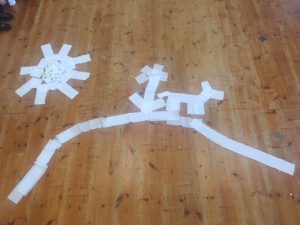
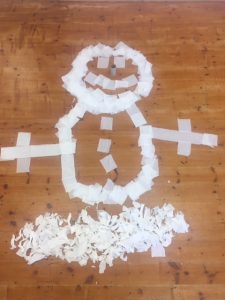
Then we made a piece of art using a toilet roll. One group was struggling, but with a small amount of guidance, were able to communicate positively with each other to resolve their disagreement and understand each others differences. I think they are starting to realise they are learning about themselves, as well as practising a variety of skills over the week.
    

Another quick task next. Stand up for 100 seconds. They all said it was easy, until I pointed out it wasn’t meant to be an endurance task. They had to stand for exactly 100 seconds, and then sit down. We did this one group at a time, and the results we varied. All over shot the 100 seconds. Fifth place were over by 92 seconds. The closest team were over by 12 seconds. Some work on estimating time me thinks.

Our final task of the day was to get an egg as high as possible, without it breaking. I insisted we did this outside as the cleaners wouldn’t thank me for getting egg on the carpet. I gave them 5 minutes to prepare, this included regular time checks and a count down from 10 to 1. Yet, I was still told by the ground who were left standing next to a tower, holding an egg, that they, ‘didn’t have enough time.’ Bizarrely, they still didn’t come last as one group put theirs in a tree. Just really low down. Lessons learnt by all.

To round the day off I set the class their End of the Day task. Tomorrow they should all come to school, wearing the most unusual hats. I can’t wait to see what happens.

DAY 3

We had a brilliant start to the day when 22 children arrived wearing an array of unusual hats. I’m not sure quite what their parents are making of all this, but we’re having a whole lot of fun in class.

Today’s opening task was to make the best paper plane. Best being the one which flew the furthest. Very straightforward.

Next up, ‘take the most impressive photograph’. They all went their separate ways, to different parts of the school, but all came back with pictures of themselves. The most impressive, was the group who had photo of three children performing handstands.

After lunch was Taskmaster PE. The children had to do something brilliant on 2 gym mats. Perhaps unsurprisingly, most interpreted the brilliant thing as being something to do with gymnastics. I was presented with a range of flips, crabs, rolls, etc. One group though acted out a scene from a football match, with the winning goal being celebrated with a back flip. Brilliant.

Then, they had to make the most impressive throw of something, into something. They could get anything they wanted, but all chose to raid the PE cupboard. Logical, given that we were in the sport’s hall. A great range of throws followed. One group held bean bags in their toes, performed a handstand and flung it at the target hoop. Unfortunately, they all missed. Impressive throwing though. The winner turned out to be a (lucky?) trick shot. They threw a basketball at a bucket, missed, bounced it off the floor and wall and then it bounced back in. Impressive or lucky?

Lots more chat about positive communication and that people tend to respond better when you speak to them nicely.

The ‘End of the Day’ task was to tweet a joke to our class twitter feed. Funniest wins.

It dawned on me today that if much easier to be the Taskmaster, when there is a clear order of winners. When it’s subjective, it’s trickier, as their teacher, to explain why one piece of art is more creative or impressive than the another.  I need to get over that, but worth considering when devising tasks. Also, the children find it much easier to grasp what is required in the tasks with a straightforward outcome (biggest, tallest, furthest, etc) rather than those tasks where they need to be more creative in their thinking.

Final day tomorrow, lots to wrap up, a big range of tasks ahead, all to play for.

DAY 4

The final day and a chance to round off a whole bunch of tasks which have been ongoing for a few days. Over night we received a few jokes from members of the class and a few from our other Twitter followers. I tested them out on the class and the one they laughed at the most was…

– Doctor, doctor, I feel like a dog.

– Ok, just hop up on the couch and I will take a look at you.

– I can’t, I’m not allowed on the furniture

Next each group had to nominate a group to give 5 points to. If they voted for their own group and did not win, they were deducted 5 points. 3 groups voted for one house and one group voted for themselves. Interesting discussion and reasoning took place.

After that we all went outside. Each group had to join hands and kick a rugby ball the length of the field. Those that fell over or broke the link of hands had to restart. I was expecting carnage, but actually, it all went rather well. Only two groups had to restart, which was a relief as the field was quite muddy, so they didn’t get too dirty.

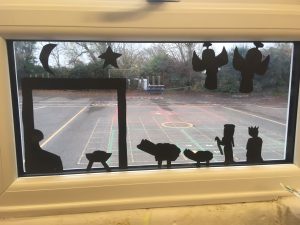
Then I gave the children some time to complete the ‘Long Term Tasks’. All failed to surprise my colleague, which was disappointing. My Head Teacher was impressed by the maths work of one child and another’s knowledge of tectonic plates. Another colleague was made to laugh out loud by one group, made to smile by another, but not so much as a snigger was caused by the others. The make Christmas silhouette for the window task was a great way to get festive, well it was for the two groups who did a brilliant job of it, two had less artistic merit, while the other explained that they didn’t have enough time. This was a complaint made on two occasions by the same group even though they had the same amount of time as the other groups, and in this case, 4 days!

Some made a valiant effort at learning The Highwayman poem, but if I’m honest, a 17 stanza poem might have been a bit optimistic on my part. It was based on the task of learning the names of every member of an Australian Rules Football team. I thought I’d try an link it to the curriculum and our topic. Definitely over stretched on that one.

The final ‘Long Term Task’ was to write a song about the week. I will forever regret saying that they could use instruments, but there you go. Lyrically, they were pretty good, and some reflected on how they had enjoyed the week and what they had learned. The singing was pretty good as well.

When they had to unveil a new handshake, I was back in the tricky place of being presented with 5 equally awesome creations and having to decide between them.

The final outside task was to score a goal with a plastic bag. Tricky on a windy afternoon. Each team member had to kick the bag at least twice before scoring. One team took a football with them, discretely so others didn’t spot it, and when I said ‘go’, they popped the ball in the bag and made light work of the task.

What I didn’t tell them, was that they needed the bag for the next task. They needed to make the bag as heavy as possible without it breaking. One group had a pretty large tear in their bag, but still managed over 4kg in the bag. The winning group had over 6kg. That seemed pretty good to me.

The final scores were incredibly close. Sycamore 95, Maple 94, Birch 91, Oak 75 and Willow 74. I had thought about making one of the tasks to make a trophy you’d want to win. But, in the end went for a certificate.

Final thoughts…

As the week went on I found it increasingly difficult to score the more subjective tasks, especially when the children all rose to the challenge and did their best. The other element that I found tricky was the timing. How long to allow for each task (this become pretty pupil led) and how long to reflect on what we’d learnt from tasks before moving on, or simply making them come thick and fast.

I will definitely do this again next year, possibly during the first week of term to establish these  positive relationships and considerate ways of communicating. In the mean time we will build on the successes of the week in class and look forward to the next series on TV.

If you do your own Taskmaster activities in school, why not use this video from Alex Horne to introduce it? The password is schooltaskmaster. Enjoy.

Taskmaster 2018 – Powerpoint of tasks

Taskmaster Sign Out Sheet – Word Doc

Taskmaster Scorecard – Word Doc