
Tag Archives: TeacherTaskmaster

Secret Tasks: The Unexpected Key to Obvious Impact

Last week, I had the pleasure of visiting Southway Primary School, where their Year 6 pupils have been running Taskmaster Club this term.

I was there to learn more about a collaborative project they’re planning with their neighbouring secondary school, TRS, and it’s an idea that’s simple but could well be extremely impactful. Older pupils from TRS will take on leadership roles, running Taskmaster Club sessions for the younger pupils and modelling collaborative teamwork and communication. It’s peer-led, it’s practical, and it’s the kind of initiative that quietly builds confidence in all age groups. I can’t wait to see what happens next and the ripple effect it has across both schools.

But that wasn’t the highlight of the visit.

The Teacher Who Introduced Me to the “Secret Task”

While speaking with a teacher who has been running Taskmaster Club with Post-16 pupils, she shared an adaptation she had made to the format. It was so clever, simple, and bursting with potential that I’ve been thinking about it ever since.

She had introduced The Secret Task.

While all of the teams were working on the same task, she privately assigned individual pupils an extra rule or personal mission to complete during the session. These were designed to shape behaviours, build skills, or push pupils slightly outside their comfort zones – all while keeping the playful spirit of Taskmaster intact.

The sorts of secret tasks she shared included:

  • Make sure your team uses your idea for at least one task today.
  • You must agree with everything everyone says.
  • Do not speak at all during the session today.
  • Sabotage your team’s attempt in some way. If your team win, they lose; if they lose, you gain bonus points; if you get caught, you lose points.

Each one requires a different kind of strategy, awareness, and self-management. And each one develops a different skill.

Why Secret Tasks Work So Well

What struck me most wasn’t just the creativity of the idea—it was the intentionality behind it.

Secret tasks give teachers an opportunity to:

1. Personalise the learning experience

Each pupil can be guided toward a specific behaviour, challenge, or strength. A quieter pupil could have a task encouraging leadership; a dominant pupil could be nudged toward active listening; someone who struggles with teamwork could be steered into building or repairing group dynamics. All while attempting the same task.

2. Strengthen inclusion and adaptive practice

We talk a lot about adaptations, but this is adaptive practice disguised as fun. It gives every pupil a way to participate meaningfully, even if their needs or strengths differ from their peers’. No one is singled out. No one is left out. Everyone plays.

3. Encourage reflection and metacognition

Secret tasks aren’t just playful – they support deeper thinking. When pupils debrief afterwards, they start to notice how behaviours influence the outcome of a team task. They learn to reflect on what worked, what didn’t, and how their own actions shaped the group.

4. Maintain the magic of Taskmaster

Taskmaster thrives on chaos, surprise, and joyful unpredictability. Secret tasks add another layer of mystery that feels perfectly in keeping with the spirit of the format.

An Obvious Impact Through Subtle Means

What I love most is how quietly transformative the secret task can be. It’s a small tweak with the potential for huge impact. When used purposefully, it allows any teacher or facilitator to:

  • build confidence
  • develop communication skills
  • challenge assumptions
  • support social interaction
  • nurture leadership
  • encourage teamwork
  • and gently shift behaviours

…all without breaking the flow of the session or drawing attention to any one pupil’s needs.

This, to me, is inclusive practice at its best: playful, personalised, and powerfully human.

What Secret Tasks Would You Add?

I left Southway feeling inspired – not just by what they’re doing now, but by the possibilities these secret tasks unlock. I’d love to hear other ideas and adaptations people are using in their clubs, classrooms, or youth group sessions.

Sometimes the smallest twist creates the biggest shift. And sometimes, a secret task is the most obvious way to make an impact.

Taskmaster in school

Last November I wrote a blog post about how we’d been inspired by the TV show Taskmaster to run a week of problem solving tasks in my school to encourage team work and positive communication. Since then one thing has lead to another and I’ve been asked by many teachers on Twitter about running Taskmaster events in schools. This post is an update on the previous one offering some insight into why and when to run Taskmaster in school.

BUT WHY?

Ultimately, a major role of schools is to prepare children to be employees of the future. Key skills required by employers, and developed through Taskmaster in school, are communication, teamwork, resilience, problem solving and decision making. In an increasingly automated world, interpersonal skills are becoming more valued as explained by Belarusian American entrepreneur Gary Vaynerchuk who says, Emotional intelligence is about to become the single most important trade’.

The beauty of the random and varied nature of the tasks means that you can tailor the tasks to the needs of your class or your school. We needed to work on our children communicating more positively with each other, so it became all about team work and leaving no one behind when completing a task. So, if you’ve got a sports focus at the moment do more of the physical outdoor tasks. If your school development plan requires you to focus on writing, do more of the writing tasks. Yes, it’s that simple.

Another benefit is that Taskmaster is a real leveller. It doesn’t simply celebrate the same, more academically or physically able children, but rewards perseverance, lateral thinking and all the other things mentioned above.

BUT WHEN?

Wherever you like. It’s your school. But below are a few examples of when other teachers have used it in schools.

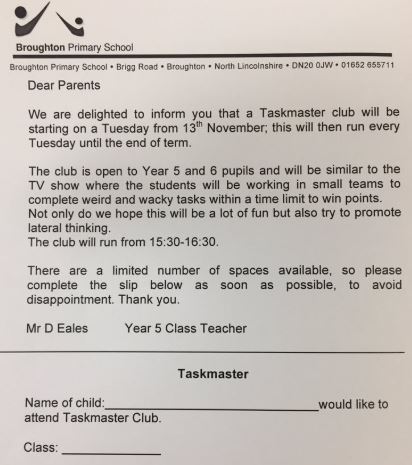
TASKMASTER AFTER SCHOOL CLUB. Darren Eales has been running a Taskmaster Club for some time now and has had a remarkable response. Where after school clubs at his school usually have an uptake of around 20 pupils, 80 children responded to the Taskmaster letter below and he’s had to limit numbers and allow different children to attend each half term.

Darren Eales Taskmaster Club letter source:
https://twitter.com/DarrenEales/status/1068772833558446080

Darren has kindly shared a load of resources in a Taskmaster Dropbox where you will find his Taskmaster after school club start up kit- Including over 30 tasks (borrowed from Taskmaster book) adapted for group tasks in schools and a simple ppt and scorecard etc.

TASKMASTER LUNCHTIME CLUB. Secondary maths teacher, Jay Sandhu runs a lunchtime club in his school and is even going to the length of having a bust of is head made as a prize for the victors. He is particularly keen on using Taskmaster as a leveller and enjoys making his top set mathematicians sweat over random tasks.

THINKING DAY. Just as everything stops for Sports Day in most Primary Schools, everything becomes Taskmaster during Thinking Day at Megan Savage‘s school. As an accredited ‘Thinking School’ they are known for encouraging thinking and how to organise thinking by using thinking maps, thinking hats and habits of the mind. This is celebrated during a whole school Thinking Day. The tasks are designed by Megan but run and scored by a group of year 6 children.

ANTI-BULLYING WEEK. In my school we were looking for ways to encourage the children to communicate more positively during Anti-Bullying Week. Being a big fan of the show I planned fours days of activities based on Taskmaster to get the children to work together and communicate well for the benefit of their whole team. I wrote about what we did in the previous Taskmaster in the Classroom blog post where you will find resources including loads of possible tasks you could attempt in school.

END OF TERM FUN. The last day of term can often involve tidying up, watching a film, playing games or a party, but for Ian Addison‘s class it was a day of Taskmaster fun. He has written about what his class got up to on his blog. I certainly believe that Taskmaster Day is considerably more productive and valuable in school than watching a film.

TRANSITION. Transition day in July or the first week back in September would also be an ideal time to introduce Taskmaster to your class. It’s a great way to see how different groups of children work together and approach these challenges in a fun and engaging way.

EVERY MONDAY. During term time, every Monday, @ClassTaskmaster set tasks for schools, classes, clubs, tutor groups, pupils, teachers, etc all over the country to be completed before the deadline using the hashtag #ClassTaskmaster. Test yourself against the rest to see if you and your team are the best. Winners announced at the end of each half term.

OVER TO YOU…

If you are planning to do Taskmaster events in your school I’d love to hear about them. Use the hashtag #SchoolTaskmaster and tweet me about it @JamesBlakeLobb. All of the teachers mentioned in this blog post are on Twitter and happy to be contacted with questions about what they did to make Taskmaster a success in their schools.

If you do your own Taskmaster activities in school, why not use this video from Alex Horne to introduce it? The password is schooltaskmaster. Enjoy.

Meeting Greg, Alex and the other Taskmaster teachers
At The One Show with Angelica, Matt and the Taskmaster teachers